
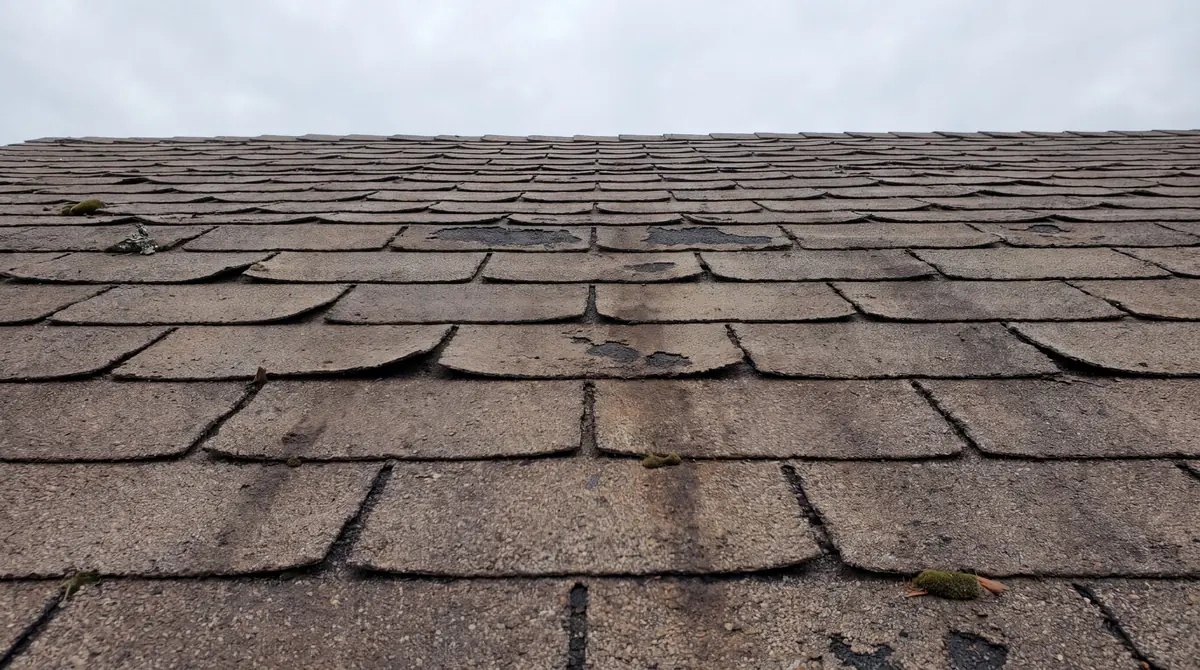
Cupping vs. clawing
Roofers use two words for curling. They look different and point to different stages.
| Item | Cupping | Clawing |
|---|---|---|
| What it looks like | The bottom edge turns up, like a shallow dish | The middle humps up while the corners stay down |
| From the ground | A ragged, wavy line along each row | Bumps or ridges in the middle of the tabs |
| Common causes | Age, heat from the attic, moisture under the shingle | Age, poor attic ventilation, shingles that have lost their oils |
| How far along | Early cupping can often be slowed | Clawing usually means the shingles are well along in age |
Why shingles curl
A shingle lies flat when the asphalt is soft enough to relax in the heat. As it loses oil, it shrinks and stiffens. The top and bottom of the shingle don't shrink at the same rate, so it bends.
Heat from the attic. A hot attic cooks shingles from underneath. In a Piedmont July, an attic that can't breathe gets far hotter than the air outside. Shingles take heat from both sides and dry out faster.
Poor ventilation. A roof needs air coming in low at the eaves and going out high at the ridge or vents. Blocked soffits, too few vents, or insulation packed against the roof deck trap heat and moisture.
Moisture. Humid air in a poorly vented attic can condense on the decking. Damp decking can push shingles out of shape.
How it was installed. Nails set too high, or shingles laid over an old layer, can lead to early curling.
If a hot, poorly vented attic is part of the cause, a treatment alone won't stop it. We'll point it out if we see signs of a ventilation problem, so you can get it looked at.
When rejuvenation helps with curling
Rejuvenation reacts with the aged asphalt, which restores flexibility. In the lab, untreated control shingles failed a pliability test at 55°F. Shingles treated with APEX-1132 passed. That bend test is explained on the lab results page.
Flexible shingles handle daily heat swings better. That can slow early curling and help shingles stay sealed down.
Be realistic about what it won't do. Treatment won't press a hard-curled shingle back flat. A shingle that has cupped and cracked at the edge has lost too much. A few of those on an otherwise sound roof can be dealt with in the tune-up. If the whole roof looks like that, it's time to get replacement quotes. Our page on rejuvenation vs. replacement lays out both sides.
Curling: treat it or not?
Good candidate
- A slight upturn at the edges on some rows
- Shingles still bend when a corner is lifted
- Curling on one face, with the rest of the roof flat
- No cracks along the curled edges
- Solid decking and no leaks
Probably past it
- Clawing across most of the roof
- Curled edges that crack or break off
- Tabs standing up so wind can catch them
- Curling caused by wet, rotting decking
- Shingles that snap during the bend test
3-tab and architectural shingles curl differently
Thinner 3-tab shingles show curling sooner and more plainly. You'll often see it on older homes around Asheboro. Architectural shingles are thicker and layered, so curling is harder to spot from the yard and tends to show up later.
Either way, the question is the same. Can the shingles still flex? Read more about 3-tab roofs and architectural shingles, or have us check yours on a free roof assessment.
Common questions
Why are my roof shingles curling?
Most curling comes from age and heat. As shingles lose their oils, they stiffen and bend out of shape. A hot, poorly vented attic speeds that up by baking the shingles from below. Moisture and install mistakes can play a part too.
Can curled shingles be flattened again?
Not once they're stiff and set. A shingle that has only just started to lift can sometimes be sealed back down in a tune-up. Treatment restores flexibility, which helps slow early curling, but it won't uncurl a hard-cupped or clawed shingle.
Do curling shingles mean I need a new roof?
Not always. A little curling on one face of a sound roof is often a good candidate for a tune-up and treatment. Curling across most of the roof, especially with cracks, usually means the shingles are near the end. The assessment will tell you which you have.
Can poor attic ventilation cause shingles to curl?
Yes. When an attic can't vent, heat and moisture build up under the roof deck. Shingles then take heat from above and below, and they dry out and curl faster. Fixing the ventilation helps the next roof as much as this one.