
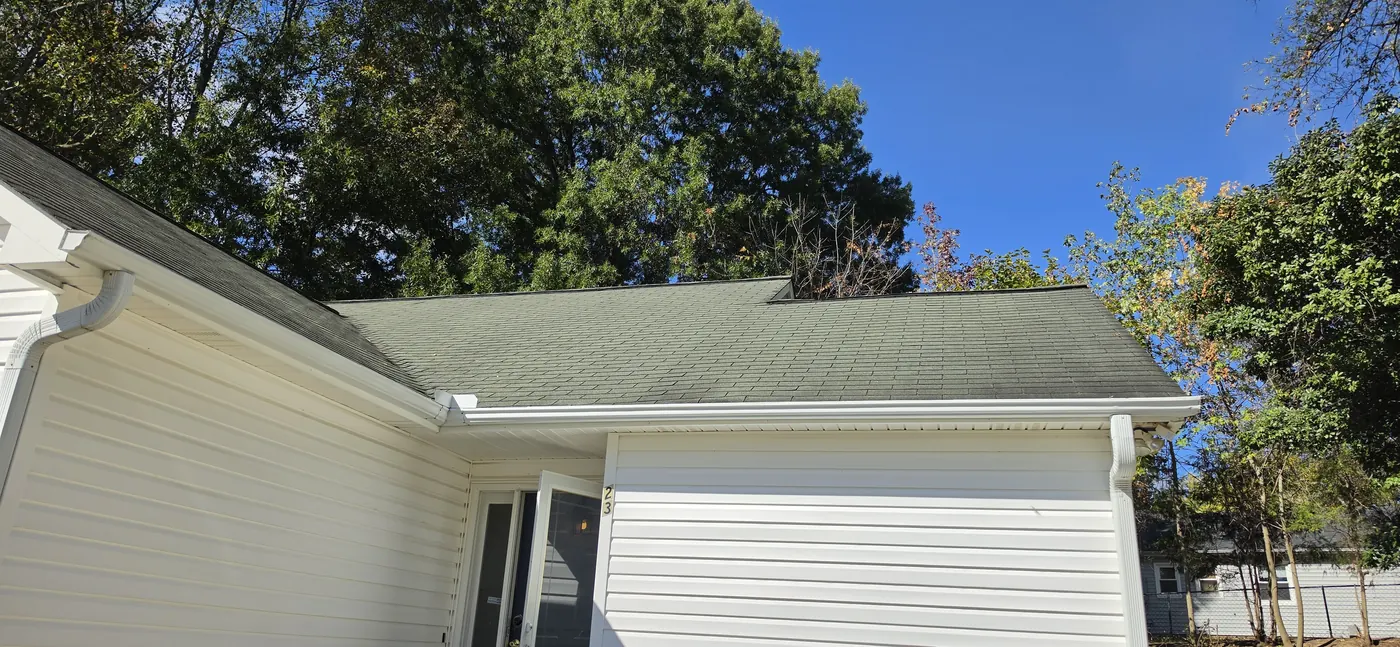
Where flashing is on your roof
Every spot where something breaks through a roof is a weak point. Flashing covers those spots. On most homes around Asheboro you'll find it in a few places:
- Chimneys. Metal pieces step up the sides and wrap the front and back.
- Walls. Where a lower roof runs into a second story or a dormer.
- Plumbing vents. A pipe boot, usually a rubber collar on a metal or plastic base.
- Attic and exhaust vents. Box vents, bath fan vents and similar.
- Skylights. Most have their own flashing kit.
The metal often lasts a long time. The weak link is the sealant and rubber around it.
Why the sealant fails first
Shingles have granules to shade them from the sun. Sealant and rubber boots don't. They sit in full sun all summer, and Piedmont heat and UV dry them out until they crack.
Then there's movement. A brick chimney and a wood roof deck grow and shrink at different rates. Every hot afternoon and cool night, the joint between them stretches a little. Over the years, the caulk pulls away and leaves a hairline gap.
Rubber pipe collars split the same way. The crack often starts at the top of the collar, where you can't see it from the yard.
Water finds those gaps. A slow drip at a chimney can rot decking and framing long before a stain shows on your ceiling. The owner checks every one of these joints during the free roof assessment.
Common flashing problems
| Item | What you notice | What it usually means |
|---|---|---|
| Chimney | A stain on the ceiling or wall near the chimney after a hard rain | Old caulk has pulled away from the brick or the metal |
| Pipe boot | A drip or stain under a bathroom or kitchen vent | The rubber collar has cracked or the seal around it failed |
| Roof-to-wall | A water mark on an inside wall below a dormer | The edge where flashing meets the siding has opened up |
| Exposed nails | Shiny nail heads on top of the flashing | Unsealed heads that let water follow the nail down |
| Rusted metal | Rust spots or flashing pulled loose | The metal itself is failing, not just the seal |
What a proper reseal involves
- 01Look close
Each chimney, wall and vent joint gets checked up close, including the uphill side you can't see from the ground.
- 02Clear the old seal
Loose, cracked sealant comes off so the new seal bonds to a clean surface.
- 03Reseal the joints
Fresh sealant goes along the open joints, over exposed nail heads and around pipe collars.
- 04Treat the shingles
Once the seals are done, the rejuvenation treatment is sprayed over the shingles around them.
Caulk can't fix flashing that has rusted through or was put in wrong. More sealant on failed metal only hides the problem for a season. If that's what we find, we'll tell you plainly.
Leaves, needles and the back of the chimney
Pine needles and oak leaves collect on the uphill side of a chimney. They sit there for weeks and hold water against the flashing. That wet pile speeds up rust and rot.
If big trees hang over your roof, keep that spot clear after leaf season. It's one of the first places a tired roof starts to leak. A flashing reseal is one of three repairs in our roof tune-up. The others are nail pop repair and securing loose shingles.
Common questions
Why does my roof leak around the chimney?
The most common reason is that the seal between the chimney and the flashing has dried out and pulled away. Brick and wood move differently with heat, so the joint opens over time. Rusted flashing or a cracked chimney crown can also let water in.
Can roof flashing be resealed, or does it need replacing?
If the metal is solid and lies flat, resealing usually does the job. If it has rusted through, bent, or was never installed right, sealant won't hold for long. We check the metal itself during the assessment and tell you which one you're dealing with.
Is flashing repair included in the rejuvenation price?
Yes. Resealing flashing is part of the tune-up that comes with every Roof Armor treatment. It's done on treatment day, before anything gets sprayed. See how the treatment works for the full day.
How often should roof flashing be resealed?
There's no fixed schedule. It depends on the sealant, the sun, and how much the joint moves. A good habit is to have it checked whenever the roof is looked at and after a big storm. We check it before every treatment, and treatments can be repeated about every 5 years.