
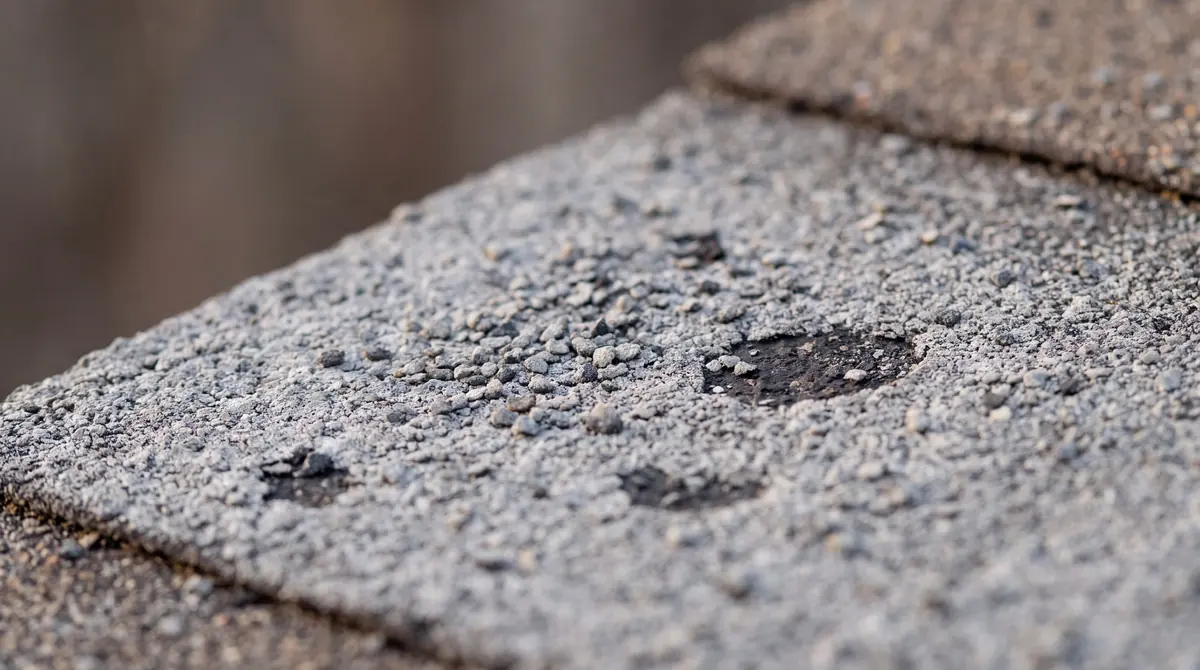
Where brittleness comes from
Asphalt stays flexible because of the oils in it. Heat and UV break those oils down, year after year. As they go, the asphalt hardens.
A hard shingle can't handle movement. The roof deck shifts a little with every hot afternoon and cool night. Wind tugs at the edges. Cold mornings stiffen everything even more. Each of those flexes puts stress on the shingle, and a brittle one cracks instead of giving.
Cracks often run across a tab or start at an edge. On older 3-tab roofs, splits that run up from the slots between tabs are common. Read more about 3-tab roofs if that's what you have.
How the bend test works
We do this on every free roof assessment. It's the quickest way to tell how dry the shingles are.
- 01Pick the worst spots
Start on the sunny faces, where shingles usually age fastest.
- 02Lift gently
Raise the bottom edge a small amount. A healthy shingle bends smoothly and settles back.
- 03Watch and listen
A brittle shingle resists, crackles, or splits along the bend.
- 04Test more than one
One shingle doesn't tell the whole story, so several spots on different faces get checked.
- 05Weigh the result
Mostly flexible with a few cracks is often a candidate. Snapping all over is not.
What the lab data says about brittleness
From SoyLei's data sheet for APEX-1132. The control is an untreated shingle.
| Item | Untreated control | Treated with APEX-1132 |
|---|---|---|
| Pliability (bend) test at 55°F | Fail | Pass |
| Tear strength | 100% (the baseline) | 86% retained |
What those numbers mean for your roof
The pliability test bends a shingle sample at 55°F to see if it cracks. That's a cool spring morning in Asheboro. The untreated control failed. The treated sample passed. In plain words, the treatment made the shingle flexible enough to bend at a temperature where the untreated one cracked. A leading competitor's product also passed.
Tear strength is how hard it is to rip the shingle. Both treatments lowered it some, which fits with anything that softens asphalt. APEX-1132 kept 86% of the control's tear strength. The leading competitor kept 70%.
These are lab results on test samples. They show what the product can do. They don't mean every cracked roof can be saved. The lab results page walks through every test on the sheet.
Can a cracked roof still be treated?
Still a candidate when
- Cracks are few and scattered
- Most shingles pass the bend test
- Cracked tabs are still in place and lying flat
- No water is getting through
- The granule coat is mostly intact
Past treatment when
- Cracks run through most of the shingles
- Pieces are breaking off or missing
- Shingles snap in the bend test on several faces
- Cracks line up with leaks or stains inside
- Decking is soft below the cracked areas
Brittle shingles crack easily, and cold weather makes it worse. Getting up there is the risky part anyway. Leave the bend test to the assessment, which is free.
What happens to the cracks you already have
Treatment won't close a crack that's already open. It helps the shingles around it stay flexible, which can slow new cracking. Cracked spots that could let water in get dealt with in the tune-up before the treatment goes on. If you're not sure where your roof stands, book a free roof assessment.
Common questions
What causes roof shingles to crack?
Mostly lost oils. Heat and UV dry out the asphalt until it's stiff, and stiff shingles crack when the roof moves with heat, cold and wind. Hail, foot traffic and poor attic ventilation can add to it.
Are cracked shingles a sign I need a new roof?
A few scattered cracks on a roof that still bends is often fixable, and the roof may be a good candidate for treatment. Cracks across most of the shingles, or shingles that snap when lifted, usually mean the roof is at the end.
Can brittle shingles be made flexible again?
Often, if they're caught in time. APEX-1132 soaks into the asphalt and reacts with it to restore some of its flexibility. In lab testing, treated shingles passed a pliability test at 55°F that untreated shingles failed. See how the soy treatment works.
Why do my shingles crack in the winter?
Cold makes asphalt stiffer, and dry shingles are already stiff. When the roof moves on a cold morning, or ice weighs on the edges, a brittle shingle has no give left. Winter is often when summer's damage shows up.